

About Courses
Why Book a Freediving Course?
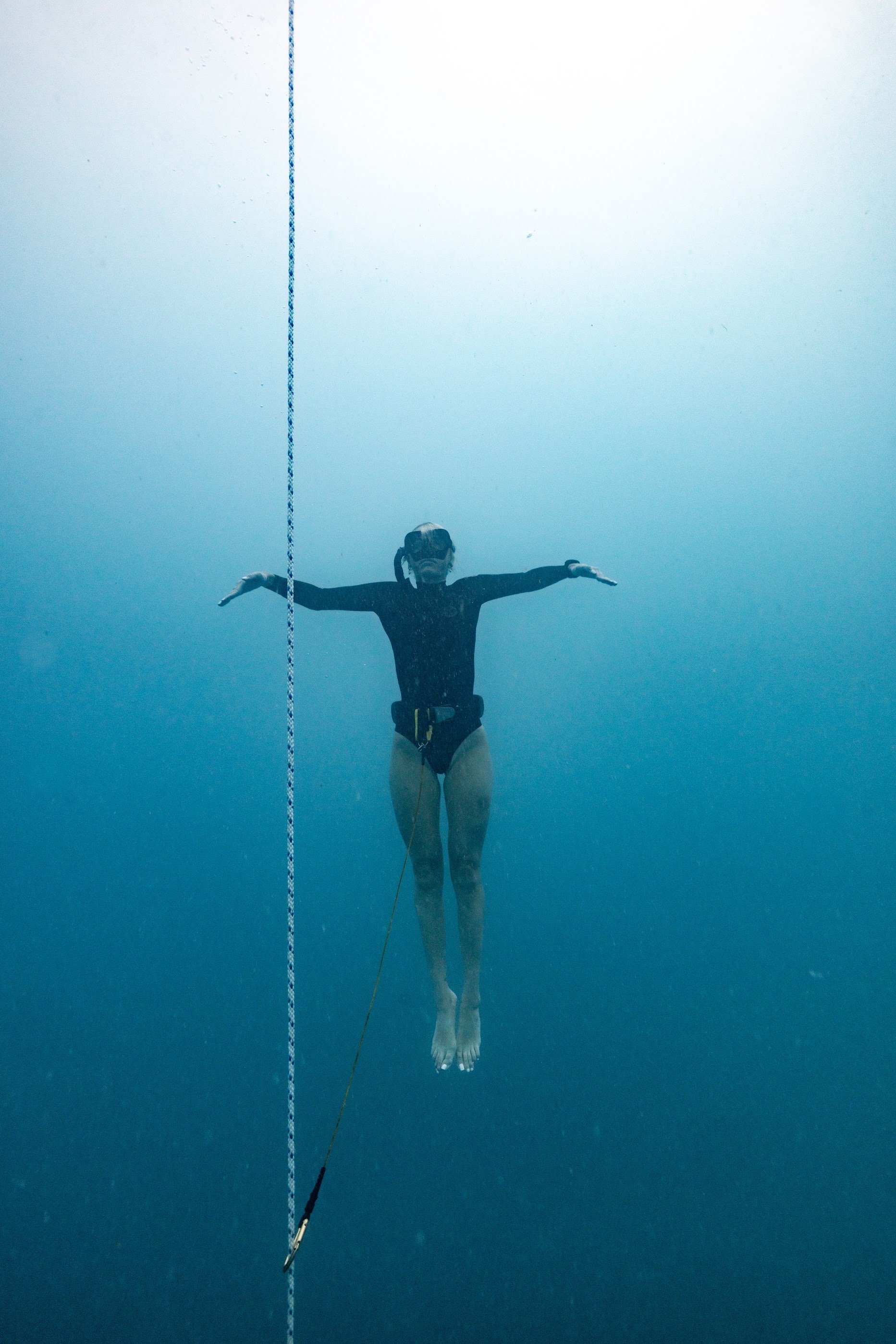
Freediving is more than just diving beneath the surface—it is a journey of breath, mindfulness, and inner peace. This sport combines breathwork, meditation, and self-awareness, allowing you to move effortlessly through the water while embracing a deep sense of calm. Freediving grants you the silence and stillness needed to truly connect with marine life, making it perfect for wildlife observation or spearfishing.
All humans are naturally equipped with the mammalian dive response, a powerful physiological adaptation that activates when we submerge. This response slows the heart rate, shifts blood to vital organs, and releases oxygen-rich blood from the spleen—helping us to dive deeper, longer, and more in tune with the ocean. We are designed by nature to explore the underwater world. Join us for a course, and discover how freediving can help you dive deep, breathe better, and connect with the ocean’s most magnificent creatures.

“Scuba diving in the ocean is like going bird watching with a leaf blower. Not only are you disruptive, but you are a menace to everything around you. If you want to connect with animals and study life in the ocean, freediving is the only way to go”
— James Nestor

Freedive Course Details
-
DAY 1:
Students will begin in the classroom, where they will cover the theoretical foundations of freediving in alignment with PADI standards for their enrolled course. This session will conclude with a short exam to reinforce prior eLearning, which must be completed before day one.
Following the classroom session, students will participate in a breathing workshop, designed to enhance breath control and relaxation techniques. They will then head to the pool for a guided breath meditation and visualization exercise, helping them prepare mentally and physically. The session will continue with the confined water component, where students must successfully demonstrate the required PADI course skills to progress and pass the course.
DAY 2:
Students will travel to the appropriate dive departure site and head out to sea. Once at our dive site, the freedive lines and floats are deployed and students will begin the PADI open ocean requirements. Once all requirements are passed, students have the opportunity to practice their new skills in a ‘fun dive’ at the dive site where they can take their snorkelling to the next level and get down with some amazing sea life.
-
To pass your respected
course, the following benchmarks are set by PADI to obtain your certification.Beginner Freediver Pool Requirements:
1 min, 30 second static breath hold
25m dynamic underwater swimBeginner Freediver Ocean Requirements:
10m constant weight deep dive
5m constant weight deep dive rescueAdvanced Freediver Pool Requirements:
2 min, 30 second static breath hold
50m dynamic underwater swimAdvanced Freediver Ocean Requirements:
20m constant weight deep dive
10m constant weight deep dive resMaster Freediver Pool Requirements:
3 min, 30 second static breath hold
75m dynamic underwater swimMaster Freediver Ocean Requirements:
32m constant weight deep dive
20m constant weight deep dive rescue -
Freediving is centered around relaxation in the water, so we highly recommend bringing your own gear that fits you well. Having the right equipment enhances comfort, promotes relaxation, and allows you to get the most out of your course. Freediving-specific fins, masks, and snorkels are recommended, but not required. For beginner to advanced levels, any well-fitting wetsuit that provides warmth and comfort is suitable. However, those moving on to the Master Freediver course may benefit from a freediving-specific wetsuit.
Our freediving courses range from $500–$600, depending on your level. This price includes:
✅ PADI Certification
✅ Mask, snorkel, and fin hire (if needed)
✅ eLearning access
✅ Comprehensive classroom theory
✅ Confined water session
✅ Breathing workshop
✅ Boat charter for open-water training
✅ Photos & videos of your experience

Spearfishing Course Details
-
DAY 1:
Students will begin in the classroom, where they will cover the theoretical foundations of freediving in alignment with PADI standards for their enrolled course. This session will conclude with a short exam to reinforce prior eLearning, which must be completed before day one.
At the conclusion of the freediving component of learning, students will then be taken through spearfishing theory. This includes gun types, gun use, fish behaviour, shark safety, laws and regulations, local spearfishing sites and target species.Following the classroom session, students will participate in a breathing workshop, designed to enhance breath control and relaxation techniques. They will then head to the pool for a guided breath meditation and visualization exercise, helping them prepare mentally and physically. The session will continue with the confined water component, where students must successfully demonstrate the required PADI course skills to progress and pass the course. This is an opportunity for students to practice diving and swimming with their speargun.
DAY 2:
Students will travel to the appropriate dive departure site and head out to sea. Once at our dive site, the freedive lines and floats are deployed and students will begin the PADI open ocean requirements. Once all requirements are passed, students have the opportunity to practice their new skills in a ‘fun dive’ at the dive site where they can take their snorkelling to the next level and get down with some amazing sea life.
-
Beginner Freediver Pool Requirements:
1 min, 30 second static breath hold
25m dynamic underwater swimBeginner Freediver Ocean Requirements:
10m constant weight deep dive
5m constant weight deep dive rescueAdvanced Freediver Pool Requirements:
2 min, 30 second static breath hold
50m dynamic underwater swimAdvanced Freediver Ocean Requirements:
20m constant weight deep dive
10m constant weight deep dive rescueMaster Freediver Pool Requirements:
3 min, 30 second static breath hold
75m dynamic underwater swimMaster Freediver Ocean Requirements:
32m constant weight deep dive
20m constant weight deep dive rescue -
Freediving is centered around relaxation in the water, so we highly recommend bringing your own gear that fits you well. Having the right equipment enhances comfort, promotes relaxation, and allows you to get the most out of your course. Freediving-specific fins, masks, and snorkels are recommended, but not required. For beginner to advanced levels, any well-fitting wetsuit that provides warmth and comfort is suitable. However, those moving on to the Master Freediver course may benefit from a freediving-specific wetsuit.
Our freediving courses range from $500–$600, depending on your level. This price includes:
✅ PADI Certification
✅ Mask, snorkel, and fin hire (if needed)
✅ eLearning access
✅ Comprehensive classroom theory
✅ Confined water session
✅ Breathing workshop
✅ Boat charter for open-water training
✅ Photos & videos of your experience
Our Freediving Course Site
-

Julian Rocks (Nguthungulli)
A hotspot for wildlife diversity and abundance, Nguthungulli is located East of Byron, 2.5km from the cape and a 15 minute boat trip from the Brunswick River. It acts as natures barricade from the harsh oceanic conditions that frequent the mid-East Coast of Australia. Its large pinnacle structure breaches the surface and offers a wind and swell barrier, protecting divers and making for an enjoyable freediving course. Its varying depth gives freedivers the chance to practice their new skills away from the freediving line and float. Rookies might like to enjoy a snorkel in ‘the nursery’ with shallow water, a large variety of coral and fish species, turtles and rays. The more experienced divers might like to try hitting deeper dives around ‘the needles’ where leopard sharks, turtles, spotted eagle rays, grey nurse sharks and the occasional manta ray like to drift. The pro divers can challenge their breath hold and skills on ‘the cod hole’ and ‘cray cave’… much deeper swim-throughs which boast surprises at every turn.